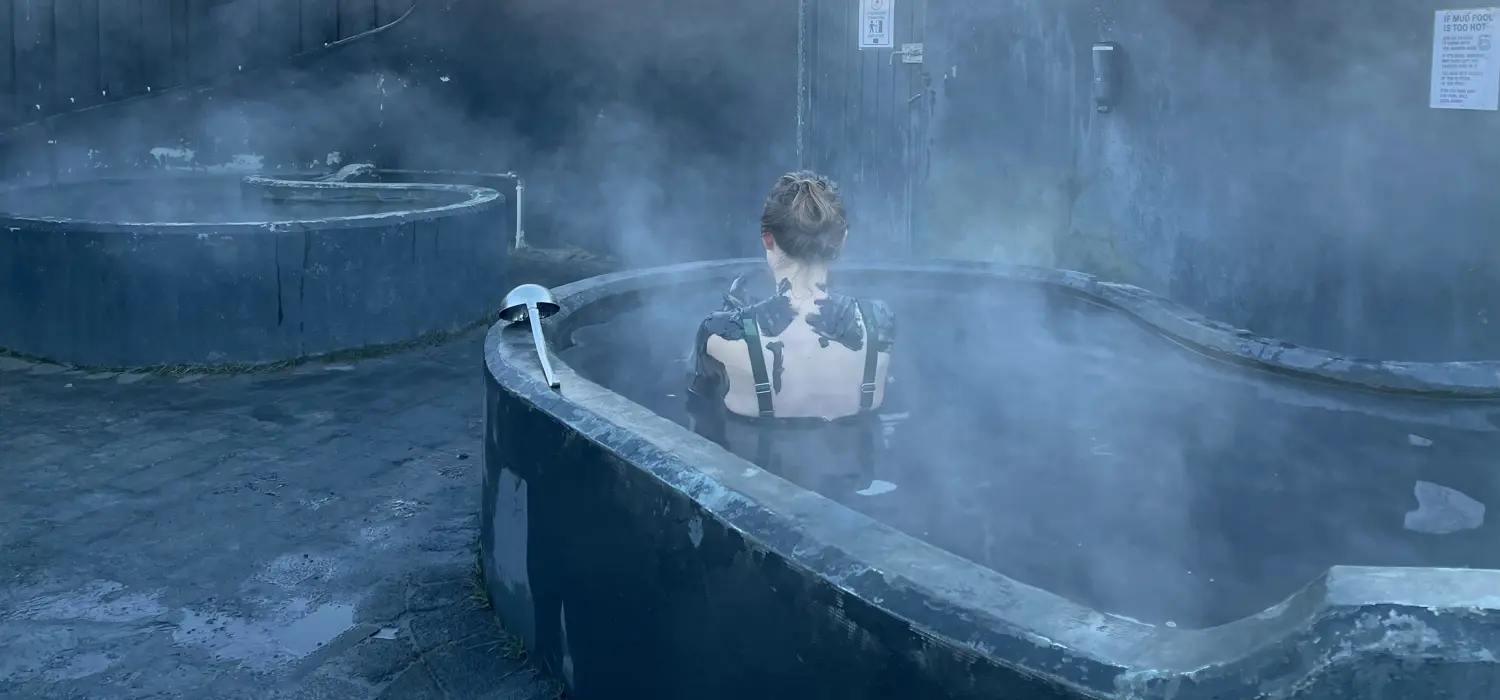
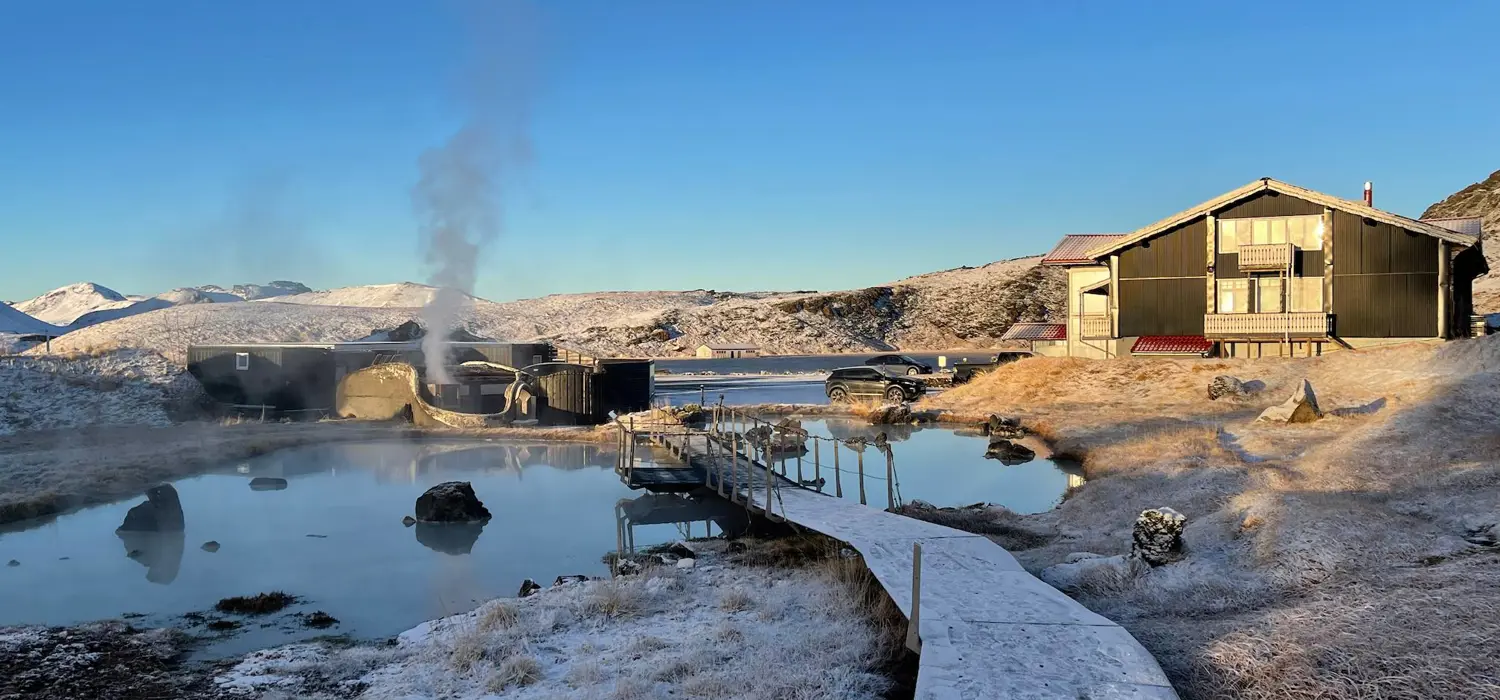
The story of the Mud Bath at Hveradalir is not a recent invention. Long before modern wellness travel became part of Iceland’s tourism landscape, people at Hveradalir were already exploring how geothermal heat, steam and mineral-rich clay could be used for rest, recovery and wellbeing. Today’s Mud Bath builds on that older tradition and gives new life to one of the most distinctive ideas in the history of the area.
Early clay baths in Hveradalir
The roots of mud bathing in Hveradalir reach back to 1927, when Anders Höyer and his wife Erika settled by the hot springs and built a house in the valley. Their years in Hveradalir were marked by creativity and experimentation. In addition to geothermal greenhouse growing and hospitality for travelers, they also offered medicinal clay baths. This is one of the earliest clear references to clay bathing at Hveradalir and shows that the connection between geothermal earth and wellbeing has deep roots at the site.
Steam, heat and the first bathhouse ideas
By the late 1930s, the idea of geothermal bathing in Hveradalir had developed further. In 1938, the first sauna was installed at the ski lodge. A newspaper quote preserved in the timeline text describes the moment in striking terms, referring to the “healing power of steam and clay from hot springs” and presenting the bathhouse as the first in Iceland to use steam from hot springs exclusively for warming and bathing people. This gives Hveradalir a special place in the early history of Icelandic geothermal bathing culture.
The 1954 clay bath experiments
One of the clearest historical snapshots of mud bathing in Hveradalir appears in a Morgunblaðið article published on 26 October 1954. The article reports that the Reykjavík Ski Club had decided to begin experiments with clay baths at the ski lodge in Hveradalir. The clay came from a nearby mud spring and was believed by knowledgeable observers to contain material comparable to the therapeutic clay used in Hveragerði for the treatment of rheumatism and other ailments. At that point, a clay bath tub had already been installed in the cellar of the lodge while the clay was being chemically analyzed.
The article adds remarkable detail. It says the clay was taken from the spring that gave Hveradalir its name, about 250 meters east of the ski lodge. It was described as soft as dough and particularly suitable for clay baths. The clay had been transferred into a bath basin in the cellar and was heated from below with pipes laid underneath. If the analysis confirmed the expected properties, treatments were to begin immediately. The article also notes that the facilities were considered excellent because the baths could take place inside the lodge itself, without guests having to move between buildings. According to the report, 20 to 30 patients a day could potentially use the baths, with each bath lasting around 10 to 15 minutes.
A wellness tradition that continued
The clay bath idea did not disappear after 1954. The timeline text records that in 1959, new managers installed a sauna in the cellar alongside the clay bath that was already there. That small detail matters, because it shows that the clay bath was not just a brief experiment or newspaper curiosity. It remained part of the lodge’s bathing and wellness facilities and continued to shape how people imagined Hveradalir as a place of geothermal rest and recovery.
From treatment to a broader spa vision
Over time, the mud bath tradition became part of a wider vision for Hveradalir. In 1984, when Carl J. Johansen took over operations at the lodge, he added a sauna and hot tubs and declared that his dream was for Hveradalir to become a true health paradise. That phrase captures something important in the site’s history. The idea of Hveradalir was no longer only about skiing, travel or mountain hospitality. It was also increasingly about geothermal wellbeing and the special qualities of the landscape itself.
The modern Mud Bath
In more recent years, plans for bathing facilities returned in a new form. The timeline records that in 2014, ambitious plans were announced for a bathing lagoon and further construction near the ski lodge. In 2021, those development plans were formally divided between the owners, with one side continuing lodge expansion and the other focusing on the bathing lagoon project in Stóridalur. By 2024, preparations for a spa and wider development around the area were still part of the future vision.
Seen in that long historical arc, the Mud Bath at Hveradalir is both new and old at the same time. It is new in its present form, but it also continues a much older tradition of using the valley’s geothermal heat, steam and mineral-rich clay for comfort, bathing and wellbeing. From the Höyer family’s medicinal clay baths in the 1920s, to the steam bath ambitions of the 1930s, to the clay bath experiments of 1954 and the health-focused visions that followed, the history of mud bathing has been part of Hveradalir for generations.
Map & Directions
Only 20 minutes drive from the center of Reykjavík
Hveradalir Parking